Friday, May 15, 2020

5 Takeaways from HDD and SSD Market Reports


We were reviewing some reports on SSD and HDD market in Q1 2020 and the impact to the memory and Storage businesses. Mark Webb, MKW Ventures Consulting, rev 0


Note: in my terminology: “enterprise” includes datacenter, cloud, hyperscale, classic enterprise definitions. Not PC, Not CE

Takeaways:

 SSD growth in Enterprise: SSD capacity grow in the Enterprise was ~125% YoY in Q1. While NAND prices stabilized in Late 2019 and then increased in Q1, The revenue for Enterprise SSD was just now approaching mid 2018 numbers. Capacity growth was accelerated by previous price crash and end result is revenue back to 2018 numbers. Since NAND prices increased recently, we would expect growth to be affected.

SSD Growth in Client: SSD Capacity increased 75% YoY in Q1 2020. Client SSD revenue is at all time high as bits have nearly tripled since the NAND price peak in mid 2018. This market is still the most competitive with very low margins but it also drives adoption of the newest NAND technologies with more layers and QLC. Client SSDs passed Client HDDs in units sold back in Q1 2019 and the gap continues to grow as client SSDs (units) outsell HDDs 2:1. Due to small size of SSDs and larger size of HDDs…. HDD Capacity outsells SSD capacity 2:1. Interesting symmetry!

Overall bit growth: this places NAND bit growth in SSDs just short of 2x per year. SSDs are where most bits are shipped and by far the fastest growth. Mobile is struggling in 2020 so NAND will require SSD growth to continue to absorb capacity and prevent inventory builds.

Market share leaders: Samsung leads in both Enterprise and in Client in capacity shipped and although the competition is working hard to gain especially in Enterprise, Samsung holds on. Intel is second in enterprise, WD is second in Client. This just in: Samsung is kinda dominant in memories

 HDD Vs SSD numbers: SSD are growing at a faster percentage than HDDs and people expect that someday SSD replace HDDs. This may happen someday but we are still a long way away from that. More bits are added to HDD than SSD every year by a wide margin. 83% of bits shipped are HDD. In enterprise 90% of bits shipped are HDD. Reasons:
a.      SSDs are faster but HDDs are still much cheaper in both client and enterprise.
b.      Client and nearline are not as performance obsessed
c.      HDD costs are dropping faster than we predicted… and innovation continues
d.      SSD dominate in the performance applications in the datacenter. But those are the dominant consumer of bits.
e.      Lots more reasons and detailed data on this

Bonus: Mission critical 10K and 15K HDDs…. A market I said should disappear in 2015 since there is no logical reason for them …. Still sell with only minor capacity erosion over time. Reason: Once something is established, enterprise is very slow to move away from it. Remember that.


Mark Webb
www.mkwventures.com


Tuesday, October 29, 2019

A Quick Summary on the Micron X100 3D XPoint SSD


A quick Summary on Micron X100 3D XPoint SSD.
THE Fastest SSD in the World!


Reminder: Micron will use the term 3D Xpoint. Intel, who owns the copyright to this term, will not use it. They use the term Optane Memory Media

Micron announced the worlds Fastest SSD, the x100 SSD. 2.5M IOPS, 9GB/Sec, 8uSec Latency. It is based on second generation 3D Xpoint. We showed the cost and density for this chip early in the year and again at FMS in 2019. And yes, we were correct in our predictions for what the chip would look like.

I bought 2 of them on Amazon last night…. JUST KIDDING!!. The product is not available to anyone yet and is supposed to sample to some select customer by the end of the year. It is apparently becoming more common to announce products that have not sampled with anyone yet. Standard qualification processes and history would indicate that the product is a year from volumes sales (More on this later).

FACTS
  • Product is a full height card.
  • Product is PCIe3 x16. If you do x16, you will get some serious bandwidth.
  • If you build a x16 SSD with 3D XPoint and optimize it for speed, it will be the fastest SSD.

Some speculation from MKW Ventures (I will confirm when I get data
  • Density wasn’t announced but someone mentioned 750GByte at meeting
  • The product is probably heavily overprovisioned and costs $1000s of dollars per SSD. It is aimed only at the fastest market. If it was available, pricing would probably be in the $10/GByte region.
  • The product is probably FPGA based. The x16, FPGA, and the overall formfactor indicate that this is test vehicle and will not ramp in volume ( ie 100s of units sold total). Micron did this before with their super fast SLC NAND SSDs and IDT controller (P320h). They were very very fast and sold in very small numbers. This is not a bad thing, it allows Micron to learn, customers to try it out, and Micron to develop a product that will ramp. Plus you can do some fun virtual memory stuff with low latency SSDs like this.
  • This product and its follow on products will compete in the low latency SSD market with Intel, Samsung, Toshiba. It’s a real market, the volumes are just very low at this time. They will follow the ramp that NVMe SSDs have over the last 6 years.
  • We don’t expect to see 3D Xpoint DIMMS from Micron anytime soon. These require custom memory controller or a NVDIMM-P or CXL or GenZ like bus. None of those are ready yet.

Summary: 
  • Micron has a 3D XPoint SSD that they will sample this year. It is second generation 4 layer 3D Xpoint
  • It is arguably the fastest SSD available (when it ships).
  • It is confirmation that Micron plans to plan in the 3D Xpoint market
Mark Webb
www.mkwventures.com


Wednesday, March 27, 2019

Memory and Storage Speeds on Optane DIMMS


Memory and Storage Speeds on Optane DIMMS

At Flash Memory Summit, I showed why 3D XPoint was advertised as 1000x faster but ended up only 7x Faster. It has to do with the fact that individual IOPS, latency, sequential read speed may or may not be limiting factor. Actual impact is always less. The best example is based on HDD to SSD comparisons from the many benchmarking sites. SSDs are technically 500x faster than HDDs… but in most applications your apps run <2x faster....


Next week, Intel will publicly update us with info on Cascade Lake and Optane DIMMS. The above mentioned challenge will be a bit of a two edged sword for Optane DIMMS.

  1. Optane DIMMS used as persistent memory will be 50 times faster than NVMe SSDs based on latency and bus speeds. This sounds great but we will find most applications do not see that level of benefit. The UCSD team did a great study on this. Whether it is worth the price and time to optimize is up to you and your applications
  2. On the other hand, Optane DIMMs used in main memory with a DRAM cache (“memory mode”) will provide tons of main memory that is theoretically 7-10x slower that DRAM RDIMMs based on latency… but actual speed difference will be less than that and if the data is “cache friendly”, maybe 90% of applications will see no measurable difference in actual use. Lots of memory, lower cost than DRAM, same measurable performance in most cases. Whether it is worth the price and time to optimize is up to you and your applications


So we will find that in actual use, Optane DIMMS are not 50x faster than SSDs… but they are not 10x slower than DRAM either. We will see what performance actual customers see in months to come

Wednesday, March 20, 2019

Cost and Performance of Optane DIMM Options in Use Today


Now that we have information on the performance of Optane DIMMs and data on recommended configurations from Intel, we are updating a blog from last year on cost and performance


Reference configuration is 192GB DRAM with 1TB NVMe SSD. 

With Optane, Intel is proposing 128GB DRAM with 1.5TB of Optane operating in memory mode (volatile/not persistent). The purpose is to add lots of cheaper, slower main memory. Persistence doesnt matter

Cost is about the same as today's configuration. What can we expect from this configuration? In theory…
·         Read Latency is 5-7x higher for Optane, but speed (MT/S) is only 3x slower for Optane. This is the same effect we see on latency vs speed in DDR2,3,4 transitions
·         Data sets larger than 192GB would run much faster on Optane DIMMS as no swapping is required with SSD
·         Datasets between 128 and 192GB would run slower because you got rid of some of the DRAM and replaced it with Optane. These now run with some of the memory running at 1/3 the speed
·         The trade off is simple. cost is the same. Do you have large datasets taking up more than 192GBs of memory? Are you OK with 1/3 the performance when accessing the Optane vs DRAM?
·         Reminder: In Memory mode the Optane is configured by controller as volatile memory.

A second configuration is App direct mode. In this mode we have true persistent memory. You can use it with load/store commands like memory or block level storage like SSDs. An example is replacing the NVMe SSD with persistent memory. Simplistic sense, Its like an SSD on the DRAM bus. Example

  •  Replace 512GB NVMe accelerator SSD with 512GBs of Optane persistent memory in app direct mode.
  • Cost goes from ~$400 for NVMe to ~$1800 for Optane DIMMs.
  • When accessing the Optane DIMM the speed is 10-50x faster depending on your metric and application.
  • It is persistent so data is never lost
  • Much more expensive but as an accelerator, much faster.

If you are an IT expert, a great summary of performance improvement seen from Optane DIMMs is shown here from the UCSD NVM Team. https://arxiv.org/abs/1903.05714

We have a matrix of lots of cost/performance options, including NVDIMMS available from other suppliers (Samsung, Netlist, Micron, Viking, Smart Modular, etc). call for more info.


Mark Webb


Monday, January 28, 2019

Five Thoughts from 2019 SNIA Persistent Memory Summit


Last week I attended the Persistent Memory Summit in Santa Clara. This is a great one day conference each year bringing together experts on Persistent Memory examples, system support, and applications. The presentations are posted and there is a video as well (thank you SNIA!)


5 thoughts:
  1. Now that persistent memory has moved from a “wouldn’t it be great if we had this?” concept to a “we have some options, now what?” debate…. We need to define “persistent memory” based on the new reality. Rob Peglar and Stephen Bates reminded us that using the term SCM is not politically correct and can only be used in a safe space away miles from a SNIA conference (Starbucks Milpitas worked for me). This is good since it was way too vague and theoretical. Andy Rudoff offered a simple definition: it needs to be address in load/store like memory (Not blocks and pages), and persistent. Speed is in the eye of the beholder but a year ago there was a definition of <2us latency in applications which I liked. The NVDIMM-N and NVDIMM-P definitions would indicate that it does not need to be one type of memory but is a DIMM or system. These simple definitions would seem to eliminate some products that are often referred to as “persistent memory” (side discussion)
  2. The most common persistent memory today arguably is NVDIMM-N which provides us with up to 32GB DIMMS that can be written to like DRAM but never lose data. The challenges here are that the use of DRAM for entire capacity plus NAND plus energy support leads to a high cost that is 3x or more per bit compared to DRAM. As a result, a small amount of systems (typically SANs) use them today. Multiple providers were at the conference and you can buy this persistent memory whenever you wish.
  3. Frank Hady presented Intel Optane Persistent Memory and the applications. Two modes, one is persistent memory (App Direct) and one is memory Mode (which loses data on power cycle). Memory mode is great for adding tons of memory that is somewhat slower and cheaper but it is not persistent per Intel documentation. This is poised to grow rapidly with Intel backing but it is off to a slow start. From talking to customers, most say they still can’t get Optane PM to build their own system and the availability today is running apps on cloud systems. I have details on modes and projected revenue in other publications
  4. NVDIMM-P is proposed as an open source version similar to Optane PM where the architecture supports some DRAM plus NAND or other memory type to optimize for cost. This will allow DIMMs that are LESS expensive than DRAM, higher density, and more non-proprietary options. We need this ASAP! When can I get one???
  5. From the conference, it feels like Infrastructure support and application drivers are ahead of the actual hardware…. This is probably not totally true but there is drive from Intel and SNIA to get all the support in place and the OS supports it and we have applications. Once Intel ships significant volume and competitors start shipping their versions of PM, we can test out all the applications

See more info on our blogs or website. Thanks to Chris Mellor of Register fame for republishing some of my FMS work on persistent memory and Optane with all the gory details and numbers.

Mark Webb
www.mkwventures.com


Tuesday, January 22, 2019

Relative Cost and Price for Optane and other Memory

Jan 2019 UPDATED: What are the relative costs for the memory types in new SSDs and DIMMs? We have the estimates below!

This was shown about a year ago and is still a good representation of what is going on. All of the costs are lower (we publish a monthly report with details).... but the summary is still true.


  • 3D XPoint is lower cost than DRAM today and is selling for half the price of DRAM or less in DIMMs and SSDs (volumes are low and yes Intel loses money on this). 
  • 3D XPoint will decrease in cost with ramp and maturity. It is not fully ramped yet as demand is not there yet. Also 2nd Gen will be 30% cheaper.
  • Optane DIMMs are now known to have a controller and DRAM on each DIMM so the DIMM has some additional cost compared to DRAM. Plus they are overprovisioned more than DRAM DIMMS
  • Fast NAND (Low Latency NAND) is still much cheaper and is useful in Fast SSDs and NVDIMM-P applications. We expect Low latency NAND from Samsung, Toshiba, WDC, and Hynix in 2019  (YMTC someday ... and yes we have data on when someday is)


Actual values, assumptions, prices and how these will change over the next two years is available as well

We will be at persistent memory summit if you want to discuss details more. Text us to chat.


#flashmem
#optane


Mark Webb
www.mkwventures.com

Wednesday, January 16, 2019

Intel Optane H10 Vs Samsung 970EVO

Intel announced an Optane H10 Hybrid SSD at CES last week. How might it compare to Samsung 970EVO on cost and performance?


Intel announced a Optane H10 M.2 SSD which will be in laptops sometime in Q2 or Q3. It combines Intel optane memory (the 16G or 32G cache for HDD) and a Intel QLC SSD all on one module. Optane/3D XPoint acts as a cache for the QLC SSD. By merging them together, Intel sells both NAND and 3D Xpoint and saves the PC manufacturer a M.2 slot. It is two SSDs on one board managed by Intel RST driver and custom firmware

Performance: we can expect that the Optane will perform like other Optane Memory tests. Lower latency on anything cached, slow down to SSD (QLC in this case) performance on huge serial transfers. This alone will make it a high performance SSD. Most likely faster than 970EVO on QD1 latency and speed, slightly slower than 970 on large file transfers or un-cached as QLC is slower than TLC in most applications. Power is unknown but historically, Optane is a power hungry technology

Cost is the key as always: Our data indicates H10 cost is slightly higher than 970EVO at 500GB, slightly lower than 970EVO at 1TB. See details below. Since Intel is highly motivated to sell this product to move its built up NAND and 3D XPoint inventory, they can price it aggressively... even at cost. This should make it a competitive product for PC OEMs. Not HDD cheap, and not as cheap as Intel's pure QLC NVMe SSD but a less expensive SSD with high NVMe performance.

It should be a solid competitor to 970EVO for the highest performance notebook storage.

H10 Review
https://www.tomshardware.com/news/intel-optane-h10-qlc-ssd,38387.html

Optane Memory Review
https://www.tomshardware.com/reviews/intel-optane-3d-xpoint-memory,5032.html

970EVO Review
https://www.tomshardware.com/reviews/samsung-970-evo-ssd-review,5573.html


We have costs for all SSDs, NAND, and new NVM technologies along with performance numbers for Optane/3d XPoint

Mark Webb
www.mkwventures.com


Sunday, December 9, 2018

NVMe SSD Capacity Growth through 2025


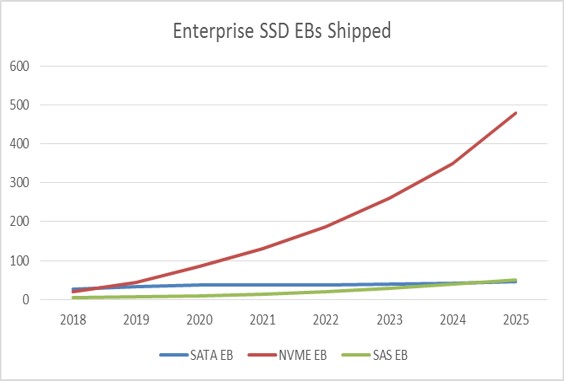
At the NVMe Developer Days Conference last week, there were multiple presentations on applications, reference designs, NVMe over Fabric solutions and examples. At the end, I presented unit and EB growth numbers for 2018 through 2025 for NVMe Devices.


Takeaway:

  • NVMe Client SSD Capacity will grow at 48% CAGR through 2025 (growth declines over time with saturation)
  • NVMe Enterprise/Datacenter Capacity will grow at 57% CAGR through 2025 (No saturation)

These numbers are based on attach rates, EB growth, shift from SATA/SAS to NVMe over time. 

  • What is needed to support this growth?: multiple solutions from multiple vendors at multiple segment levels for NVMe. This will bring price drops needed. This has already started in 2018 and is expected to continue
  • What is limiting this?: Enterprise storage is a slow, conservative business. 15K HDDs continue to sell by the millions despite being an inferior solution to SSDs in performance applications.  


Call for more information on how NVMe is transforming the future of storage

Mark Webb


Wednesday, July 18, 2018

Optane DIMMs: What is it, how fast, how much?


You got questions? We got Answers. A while back, Intel announced more about Optane DIMMS for data center. Vague information on when customers can get it ("select customers some time in 2018, volume sometime in 2019"). No information on speed or endurance. Densities are 128GB-512GB DIMMS. Fortunately we at MKW Ventures have models for what it is and how it works and how much it costs. Updates below with lots of additional information available.

While you can't buy it today and we don't know when you can buy it, Intel committed that you can test it out in the cloud sometime soon.


Questions from My January Blog and some answers based on a our model
  • What is in a Optane DIMM? its up to 10 XPoint packages+ smaller controller, power unit and buffers. It has 20% overprovisioning on the DIMM plus about 10% overprovisioning on the chip itself
  • How fast will an Optane DIMM be? Intel says it works at DDR4 speed we assume this is 2133-2666+ MT/S. Latency is between DRAM and NAND (we can discuss the actual latency)
  • What will the price be? Servers with Optane DIMMS will be very expensive. Standard case will be 192GB of RDRAM plus 1TB of Optane DIMMS. In this case, the price just for the DRAM and Optane will be >$7500 
  • What is the optimal DRAM DIMM to Optane DIMM ratio in a server configuration? Intel initial configuration is 1:5. Still need lots of DRAM as >90% of operations access the DRAM, not the Optane.
  • How many applications will have been optimized for persistent memory by end of 2018? lots are in development now. But Optane will be in less than 10% of servers being sold in December 2018
More ...new ... questions from May 30th presentation

  • What is endurance of Optane DIMM: Intel said they will last as long as system. We have modeled actual cycles possible and how it is managed to meet the criteria Intel committed to
  • Is it really DDR4 compatible: on size and electrical and thermal.... the answer is "sort of". We have the details but it depends on the motherboard.
  • Why do I still need DRAM in large amount on my server? correct ratio of Optane to DRAM is 5:1 to 10:1. We have models why this is
Intel won't provide the info on Availability, latency, cost, price, % of systems that will have optane DIMMs. Fortunately we will provide that to you and we can discuss in person at Flash Memory Summit in August

Mark Webb

Relative Memory Costs for Today's SSDs and DIMMs

UPDATED: What are the relative costs for the memory types in new SSDs and DIMMs? We have the estimates below!


We updated 3D XPoint and Optane costs with actual cost today vs what is should cost if it was mature and running in high volume.

Fast NAND is what we estimate for a Z-NAND type product. Other companies are working on similar Fast NAND products
                                                                                                 
Actual values, assumptions, prices and how these will change dramatically over the next two years is available as well

#flashmem
#optane


Mark Webb
www.mkwventures.com

Tuesday, February 6, 2018

HDD Trends and Impacts

 Multiple reports are coming out from industry analysts (Trendfocus, IDC, IHS, Gartner) on the HDD market for past year. Some interesting numbers on Units, Density, Cost, and Markets:


  • HDD Units relatively flat in 400Mu unit range for past 2 years (down from 2010 peak ~600M Units) . Less PCs sold and SSD encroachment in notebooks reduced TAM. 
  • HDD Capacity increasing 15% per year or more
  • HDD Mission critical (10K+15K) units down 25% from peak in 2012, Revenue down 50%
  • HDD Mission critical  (10K+15K) capacity is flat for past 2 years
  • HDD PC Capacity is relatively flat for past few years. CE and Enterprise Capacity is up.
  • HDD Cost and price per TB is down 12%+ per year. 500GB HDDs sell for less than $30 to PC OEMs


Lots more data available and how this affects the NAND/SSD market over the next few years

Some thoughts:

  • 10K and 15K market should be dead. SSDs are better and lower price per IOP... but its a slow death (Even though HDD makers 
    • SSDs should be this entire market with 25M units or more per year
    • SATA/PCIe will take this over in next 3-5 years
  • HDD Nearline market is growing rapidly with little impact from SSDs expected. >6TBs per drive at a cost well below $30/TB and costs dropping 10-15% per year. The date explosions is driving this market for storage
  • Now that NAND shortage is over, we expect SSDs resume steady penetration into PC market. Most PCs still ship with HDDs today. 
  • We are still several years away from SSD units outselling HDD Units . 10+ years from SSD capacity outselling SSD capacity


Mark Webb
www.mkwventures.com


Friday, February 2, 2018

Relative Costs for NAND, ZNAND, Optane Memory

What are the relative costs for the memory types in these new SSDs? We have the estimates below!


Caveats:


  • These are costs, not prices. Margins vary
  • These are approximate costs in 2018 for the memory in key products
  • All are relative to HDD costs


HDD is of course the cost leader... everything else falls into a spectrum of costs. Some products are more mature than others and that affects their cost today


Actual values, assumptions, prices and how these will change dramatically over the next two years is available as well

Mark Webb
www.mkwventures.com


Friday, January 26, 2018

How much will Persistent Memory Options Cost in 2019?


I recently attended the Persistent Memory Summit 2018. 

It was an outstanding conference and I was able to learn a lot on what some options for persistent memory configurations will be in 2019 and beyond. Spoiler Alert: Optane DIMMS are involved in both cheapest and most expensive options


 I converted it to customer cost for Storage/Memory components in the system for some typical options including a medium SSD and big HDD

If you disagree, please tell me the correct answer (hint: Facebook, Intel, Dreamworks... my email is below). 

I have specifics on why these options are probable, what the actual speeds are, and the costs for each components. Contact us for more info and system requirements estimates

Background Assumptions
  • DRAM is fastest, Optane is somewhat slower  but good enough. DRAM acts as cache for Optane DIMMS (Optane requires DRAM, it doesn't replace DRAM)
  • NVDIMM-N is DRAM speed... and DRAM density ... and more expensive than DRAM. But Persistent!
  • You still need to store stuff and HDD is about 50x cheaper than Optane, 10x cheaper than SSD
The Hypothetical Costs to a end user for some typical options


  • If you want TONS of addressable memory, Optane DIMMS might be the answer
  • If you want speed and persistence, NVDIMM-N might be the answer
  • If you want max speed and not persistence DRAM only might be the answer
  • If you are cheap: 64GB of DRAM plus an off brand SSD from Craigslist will do the trick
Just an opinion!

Mark Webb


Wednesday, January 24, 2018

Persistent Memory Summit 2018

Persistent Memory Summit 2018

Today is the summit that brings together many of the people working in persistent memory to discuss the future, standards, and technologies.

There will be lots of discussions on standards, programming models, and changes to computing. But there are a few pragmatic questions we are getting answers to as well this week


1) Today's Technologies: NVDIMM-N is here today and is in use in many applications. How big is the market, who are the leaders, and how fast is it growing?

2) Tomorrow's Technologies: Intel has been talking about Optane DIMMs for a long time. But customers are still waiting for production DIMMs and the CPU to go with it. Are we on track for Sep 2018 availability

3) Software to take advantage of these technologies can be slow to come out. When are the leaders planning on being able to fully take advantage of large persistent memory. If I have 1-2TB of Memory... are we ready for it?

4) Overall Market... if we look at NVDIMMS from all technologies... when do we get to the bit shipments being same as DRAM DIMMS? density is 10x... so it should be quick!


Mark Webb
www.mkwventures.com


Sunday, January 7, 2018

SSD Growth Forecast in Compute Markets: Enterprise/Datacenter

Datacenter/Enterprise: SSDs provide 30% of units and  15% of capacity sold in 2017. 


Projections for ALL SSDs and applications from a number of outlets are 15-19% unit growth and 15-20% Revenue growth. We have all the details behind those numbers if you want them but some specifics on SSD/HDD ratio on Enterprise/Datacenter


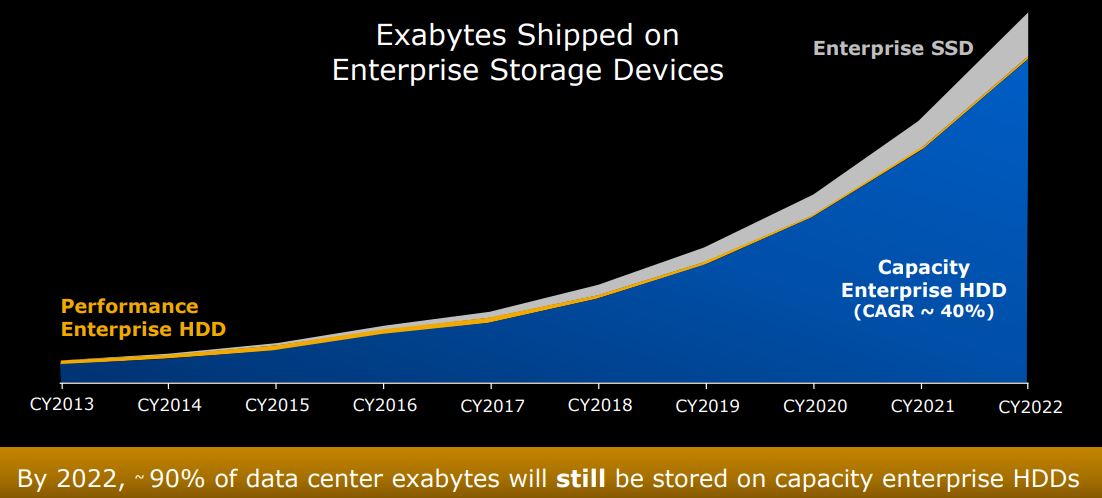
SSD% of total Enterprise HDD+SSD unit sales finished 2017 just around 30%, climbing from 23% in 2016. For 2018 we predict continued growth to 36%.  Due to nearline and Cold storage HDD dominance, SSDs provide <15% of the new capacity sold in the enterprise today. 

Note: SSDs are less than 15% of NEW capacity sold. they are less than 10% of total capacity


By Application:

  • SSDs replace mission critical 10K/15K HDDs at a very fast rate as cost per IOPs is equivalent or better. SSDs should replace 90% of this market eventually
  • SSDs in server markets are growing steadily in PCIe and SATA applications
  • SSDs continue to make little impact in nearline and cold storage applications
  • TLC utilization will support SSD growth in all applications

Reasons for methodical increase:

  • SSD $/GB Pricing is still 10x HDD Pricing in most enteprise applications
  • SSD Prices are dropping but so are HDD prices. no crossover coming
  • Anything with $/IOPS Metric is moving to SSD. Anything with $/GB Metric (Nearline/Cold) is staying HDD
  • Enterprise customers are slow to move and change configurations. 10K/15K HDDs still sell even though there is limited rationale for using them over SSDs
For details on attach rates, SSD pricing, HDD pricing, and cost assumptions over the next 5 years, contact us!

From WDC presentation 90% of data is still HDD in 2022:


Side note: Optane (p4800x) and Fast NAND applications (Z-NAND and products from WDC/Hynix/Toshiba) will impact server NVMe SSDs sales for fastest applications. The Jury is still out on how much of a premium customers are willing to pay over NAND SSDs. 


Wednesday, January 3, 2018

SSD Growth Forecast in Compute Markets: Client Notebooks


SSD sales are growing and attach rate is increasing in all compute markets. The question is: How Fast? How Much?     

Projections for SSDs from a number of outlets are 15-19% unit growth and 15-20% Revenue growth. We have all the details behind those numbers if you want them but some specifics on attach rates. 


Client Notebook SSD attach rate finished 2017 just around 50%, climbing from 20% in 2014. For 2018 we predict continued steady growth fueled by SSD/NAND price drops. The average attach rate for 2018 will exceed 55%  ... growing to almost 70% by end of 2019..... if NAND Prices start to drop as expected. No tipping point is coming.... 

Reasons for methodical increase: 

  • SSD $/GB Pricing is still 8x HDD Pricing
  • SSD Prices are dropping but so are HDD prices. SSD $/GB multiplier is 3x HDD in 2021
  • Many people still want large capacity drives
  • SSD performance is better than HDD, but it is not required for any application
For details on attach rates, SSD pricing, HDD pricing, and cost assumptions over the next 5 years, contact us!

Side note: at this point, we dont see an impact of Optane SSDs or Memory on these numbers. Optane doesn't impact notebook market at this time. See Desktop report summary for impact on that market.

Mark Webb


Friday, November 17, 2017

Optane DIMMS: What will we learn in next 6 months?


This past week Intel announced more Optane SSDs for Client and Enterprise. These are nice products, faster than NAND based products in most metrics, and available at 2-3x the prices of NAND based products. But these products are not the highest and best use of 3D Xoint. And Samsung has announced competing products.

In a separate announcement, Navin Shenoy stated that Optane DIMMs will be available in servers in 2H 2018 and that the market could be $8B for Optane DIMMS in 2021. This is far higher than all other Optane or 3D Xpoint applications combined. Optane is meant for DIMMS.

Over the next few months, we will investigate and learn a few things that will confirm or reject that $8B opportunity that Intel announced.


  • What is in a Optane DIMM? How much DRAM is onboard? That will determine the cost.
  • How fast will an Optane DIMM be? People say it works at DDR4 speed. Is the speed really the same speed as DDR4 Server DIMMs?
  • What will the price be? Some companies will want to max out server memory and Optane DIMMs will have high capacity. But most companies will make trade off decisions on price vs performance. Initial comment from Intel was "half the price". As long as its the same speed as server DRAM DIMMs that will be game changing. If its slower .... hmmm.
  • What is the optimal DRAM DIMM to Optane DIMM ratio in a server configuration? 1:1? 2:1? 1:2? 1:12?
  • How many applications will have been optimized for persistent memory by end of 2018? All of the above comments basically ignore the "persistence" aspect. NVDIMMs have been around for a while and only 1-2% of servers are using them. Will Optane change this? 

Fortunately, we will have answers to all these questions before modules are available in 2H 2018. I am sure Intel will share all the details and specifics! Wait .... what??? OK... you will have to get the details from us instead.

Mark Webb
www.mkwventures.com


Sunday, October 15, 2017

Where Do Optane DIMMS Fit In?


An over-simplified look at Storage/Memory options for Servers. 

When you need more memory, NVM, and are willing to sacrifice some speed, Optane DIMMS make sense. They should be available early in 2018?


  • DRAM DIMM alone is fastest and has lots of suppliers
  • NVDIMM-N is available at high cost if NVM is needed
  • Optane DIMMS allow more Random access memory at lower cost. its NVM. It is slower than DRAM.
  • SSDs are improvement on HDD. Optane SSDS are fastest (latency) SSDs available
  • Optane DIMMS take off in volume if the cost is significantly lower than DRAM DIMMS.


Option
Speed
Cost
Notes
NAND NVMe SSD
+
$
Fast enough for most
Optane SSD
++
$$
Fastest SSD Around
Optane DIMM                 
++++
$$$
Assume minimal DRAM
DRAM only
++++++
$$$$
Fastest, but not  NVM
NVDIMM-N
+++++
$$$$$
NAND+DRAM


HDDs are dead? On life support? Or enjoying mature lifestyle?


I saw more articles this week on death of HDD. Or that they will be dead in a couple years. If we want to use aging analysis, they are mid 50s, past midlife, not getting any younger but still active, healthy, and planning on watching their grandchildren grow for a couple decades.


Recent data:
  • HDD units outship SSDs more than 2:1
  • HDD Bits outship SSDs 10:1
  • HDD increase in bits shipped was larger than SSD increase in bits.
  • HDD units are dropping and EBs shipped are increasing at modest rates.


What is happening:
  • SSDs are increasing penetration in PCs at a modest rate. Hovering around 50% by end of year
  • Performance enterprise HDDs are being replaced by SSDs. But 10K and 15K HDDs still are close in sales to Enterprise SSDs. Even though there is no technical reason for this.
  • Nearline HDDs are growing in capacity shipped. SSDs are a small cache (<2% of capacity)
  • Slow capacity storage is 99% HDD or Optical or Tape


Why:
  • SSDs still cost 7-10X more than HDDs per Bit. It turns out we are storing bits? Who knew?
  • HDD ASP decreased in last year, SSD ASP increased. That was not supposed to happen.
  • Nearline and enterprise capacity needs are driving large increase in HDD capacities.


Prediction:
  • SSD ASP per bit being lower than HDD is almost a fantasy now. 2025 for being “close/ 2x”
  • SSD penetration into PCs will grow from ~50% to ~70% over the next 6 years
  • SSD will continue to grow at steady, no tipping point, rate. SSDs will account for 25% of bits shipped by 2022… or 2024 …. Or 2026 … let’s just say a long time
Mark Webb
www.mkwventures.com


Wednesday, March 29, 2017

3D Xpoint Optane for Enterprise and Consumer


Optane 3D Xpoint for Enterprise and Consumer


Intel announced more updates on status of their Optane products. I wanted to say launched but then I realized that actually no product is yet available to the public... soon it will be I hope.


1) Enterprise P4800x SSD: Its arguably the fastest SSD in the world depending on which metric you choose. Intel's focus is on low latency... which is important since transactions involving a queue depth of  32 are quite rare. Its also expensive and only shipping in one density and limited quantities to limited customers. It also supports a virtual memory activity where it looks like memory to the server. Still waiting on third party benchmarks but at this point it is fast and shipping somewhere for revenue.

On the downside, the internet is exploding with "it was supposed to be 1000x faster with 1000x endurance!!!!" and "I waiting 18 month for this?!!!!" .

OK its 8-10x faster and the cells last 2-3x as long as NAND. Its still a great drive for certain Enterprise Applications.


2) Intel Optane memory: This was announced to press at same time... but embargoed for a few more days. 16/32GB cache device announced also at CES.

As I mentioned when this came out earlier at CES... caching is a great idea. 95% of the performance at much lower cost... when it works. Intel showed data that when combined with a HDD is improved boot and program loading performance. There is some concern that these metrics were cherry picked but we will see when third party benchmarks comes out (THG???? Anandtech???)

The price was good $44-$77, it makes a difference in performance, and Intel is hyping the heck out of it. If PC OEMS push it... it could be a big deal. I am not sure what percentage of chipsets accept it today, but I will try it out ASAP when it comes out (See... Intel even tricked me into buying a Kaby Lake PC with 200 Chipset!).

It it better than more DRAM? or a 256GB SSD? who knows for now.


This just in... Optane, as a NVMe SSD/Cache is not 1000x faster and is not going to change the world like the steam engine, the internet, or the cell phone (SORRY) ... but it appears to be a option for fast performance in some applications ... if you can buy it somewhere.

More to come when it actually appears!

Mark Webb
www.mkwventures.com