Tuesday, January 22, 2019

Relative Cost and Price for Optane and other Memory

Jan 2019 UPDATED: What are the relative costs for the memory types in new SSDs and DIMMs? We have the estimates below!

This was shown about a year ago and is still a good representation of what is going on. All of the costs are lower (we publish a monthly report with details).... but the summary is still true.


  • 3D XPoint is lower cost than DRAM today and is selling for half the price of DRAM or less in DIMMs and SSDs (volumes are low and yes Intel loses money on this). 
  • 3D XPoint will decrease in cost with ramp and maturity. It is not fully ramped yet as demand is not there yet. Also 2nd Gen will be 30% cheaper.
  • Optane DIMMs are now known to have a controller and DRAM on each DIMM so the DIMM has some additional cost compared to DRAM. Plus they are overprovisioned more than DRAM DIMMS
  • Fast NAND (Low Latency NAND) is still much cheaper and is useful in Fast SSDs and NVDIMM-P applications. We expect Low latency NAND from Samsung, Toshiba, WDC, and Hynix in 2019  (YMTC someday ... and yes we have data on when someday is)


Actual values, assumptions, prices and how these will change over the next two years is available as well

We will be at persistent memory summit if you want to discuss details more. Text us to chat.


#flashmem
#optane


Mark Webb
www.mkwventures.com

Wednesday, January 16, 2019

Intel Optane H10 Vs Samsung 970EVO

Intel announced an Optane H10 Hybrid SSD at CES last week. How might it compare to Samsung 970EVO on cost and performance?


Intel announced a Optane H10 M.2 SSD which will be in laptops sometime in Q2 or Q3. It combines Intel optane memory (the 16G or 32G cache for HDD) and a Intel QLC SSD all on one module. Optane/3D XPoint acts as a cache for the QLC SSD. By merging them together, Intel sells both NAND and 3D Xpoint and saves the PC manufacturer a M.2 slot. It is two SSDs on one board managed by Intel RST driver and custom firmware

Performance: we can expect that the Optane will perform like other Optane Memory tests. Lower latency on anything cached, slow down to SSD (QLC in this case) performance on huge serial transfers. This alone will make it a high performance SSD. Most likely faster than 970EVO on QD1 latency and speed, slightly slower than 970 on large file transfers or un-cached as QLC is slower than TLC in most applications. Power is unknown but historically, Optane is a power hungry technology

Cost is the key as always: Our data indicates H10 cost is slightly higher than 970EVO at 500GB, slightly lower than 970EVO at 1TB. See details below. Since Intel is highly motivated to sell this product to move its built up NAND and 3D XPoint inventory, they can price it aggressively... even at cost. This should make it a competitive product for PC OEMs. Not HDD cheap, and not as cheap as Intel's pure QLC NVMe SSD but a less expensive SSD with high NVMe performance.

It should be a solid competitor to 970EVO for the highest performance notebook storage.

H10 Review
https://www.tomshardware.com/news/intel-optane-h10-qlc-ssd,38387.html

Optane Memory Review
https://www.tomshardware.com/reviews/intel-optane-3d-xpoint-memory,5032.html

970EVO Review
https://www.tomshardware.com/reviews/samsung-970-evo-ssd-review,5573.html


We have costs for all SSDs, NAND, and new NVM technologies along with performance numbers for Optane/3d XPoint

Mark Webb
www.mkwventures.com


Sunday, December 9, 2018

NVMe SSD Capacity Growth through 2025


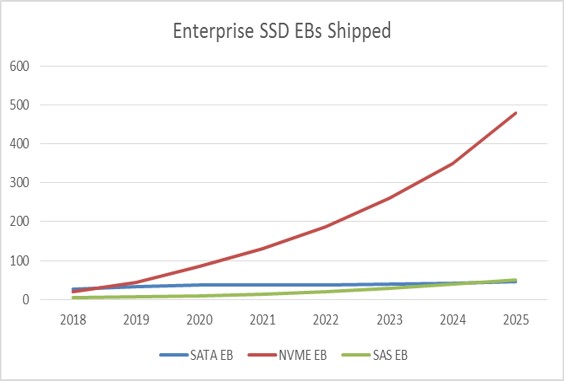
At the NVMe Developer Days Conference last week, there were multiple presentations on applications, reference designs, NVMe over Fabric solutions and examples. At the end, I presented unit and EB growth numbers for 2018 through 2025 for NVMe Devices.


Takeaway:

  • NVMe Client SSD Capacity will grow at 48% CAGR through 2025 (growth declines over time with saturation)
  • NVMe Enterprise/Datacenter Capacity will grow at 57% CAGR through 2025 (No saturation)

These numbers are based on attach rates, EB growth, shift from SATA/SAS to NVMe over time. 

  • What is needed to support this growth?: multiple solutions from multiple vendors at multiple segment levels for NVMe. This will bring price drops needed. This has already started in 2018 and is expected to continue
  • What is limiting this?: Enterprise storage is a slow, conservative business. 15K HDDs continue to sell by the millions despite being an inferior solution to SSDs in performance applications.  


Call for more information on how NVMe is transforming the future of storage

Mark Webb


Wednesday, July 18, 2018

Optane DIMMs: What is it, how fast, how much?


You got questions? We got Answers. A while back, Intel announced more about Optane DIMMS for data center. Vague information on when customers can get it ("select customers some time in 2018, volume sometime in 2019"). No information on speed or endurance. Densities are 128GB-512GB DIMMS. Fortunately we at MKW Ventures have models for what it is and how it works and how much it costs. Updates below with lots of additional information available.

While you can't buy it today and we don't know when you can buy it, Intel committed that you can test it out in the cloud sometime soon.


Questions from My January Blog and some answers based on a our model
  • What is in a Optane DIMM? its up to 10 XPoint packages+ smaller controller, power unit and buffers. It has 20% overprovisioning on the DIMM plus about 10% overprovisioning on the chip itself
  • How fast will an Optane DIMM be? Intel says it works at DDR4 speed we assume this is 2133-2666+ MT/S. Latency is between DRAM and NAND (we can discuss the actual latency)
  • What will the price be? Servers with Optane DIMMS will be very expensive. Standard case will be 192GB of RDRAM plus 1TB of Optane DIMMS. In this case, the price just for the DRAM and Optane will be >$7500 
  • What is the optimal DRAM DIMM to Optane DIMM ratio in a server configuration? Intel initial configuration is 1:5. Still need lots of DRAM as >90% of operations access the DRAM, not the Optane.
  • How many applications will have been optimized for persistent memory by end of 2018? lots are in development now. But Optane will be in less than 10% of servers being sold in December 2018
More ...new ... questions from May 30th presentation

  • What is endurance of Optane DIMM: Intel said they will last as long as system. We have modeled actual cycles possible and how it is managed to meet the criteria Intel committed to
  • Is it really DDR4 compatible: on size and electrical and thermal.... the answer is "sort of". We have the details but it depends on the motherboard.
  • Why do I still need DRAM in large amount on my server? correct ratio of Optane to DRAM is 5:1 to 10:1. We have models why this is
Intel won't provide the info on Availability, latency, cost, price, % of systems that will have optane DIMMs. Fortunately we will provide that to you and we can discuss in person at Flash Memory Summit in August

Mark Webb

Relative Memory Costs for Today's SSDs and DIMMs

UPDATED: What are the relative costs for the memory types in new SSDs and DIMMs? We have the estimates below!


We updated 3D XPoint and Optane costs with actual cost today vs what is should cost if it was mature and running in high volume.

Fast NAND is what we estimate for a Z-NAND type product. Other companies are working on similar Fast NAND products
                                                                                                 
Actual values, assumptions, prices and how these will change dramatically over the next two years is available as well

#flashmem
#optane


Mark Webb
www.mkwventures.com

Tuesday, February 6, 2018

HDD Trends and Impacts

 Multiple reports are coming out from industry analysts (Trendfocus, IDC, IHS, Gartner) on the HDD market for past year. Some interesting numbers on Units, Density, Cost, and Markets:


  • HDD Units relatively flat in 400Mu unit range for past 2 years (down from 2010 peak ~600M Units) . Less PCs sold and SSD encroachment in notebooks reduced TAM. 
  • HDD Capacity increasing 15% per year or more
  • HDD Mission critical (10K+15K) units down 25% from peak in 2012, Revenue down 50%
  • HDD Mission critical  (10K+15K) capacity is flat for past 2 years
  • HDD PC Capacity is relatively flat for past few years. CE and Enterprise Capacity is up.
  • HDD Cost and price per TB is down 12%+ per year. 500GB HDDs sell for less than $30 to PC OEMs


Lots more data available and how this affects the NAND/SSD market over the next few years

Some thoughts:

  • 10K and 15K market should be dead. SSDs are better and lower price per IOP... but its a slow death (Even though HDD makers 
    • SSDs should be this entire market with 25M units or more per year
    • SATA/PCIe will take this over in next 3-5 years
  • HDD Nearline market is growing rapidly with little impact from SSDs expected. >6TBs per drive at a cost well below $30/TB and costs dropping 10-15% per year. The date explosions is driving this market for storage
  • Now that NAND shortage is over, we expect SSDs resume steady penetration into PC market. Most PCs still ship with HDDs today. 
  • We are still several years away from SSD units outselling HDD Units . 10+ years from SSD capacity outselling SSD capacity


Mark Webb
www.mkwventures.com


Friday, February 2, 2018

Relative Costs for NAND, ZNAND, Optane Memory

What are the relative costs for the memory types in these new SSDs? We have the estimates below!


Caveats:


  • These are costs, not prices. Margins vary
  • These are approximate costs in 2018 for the memory in key products
  • All are relative to HDD costs


HDD is of course the cost leader... everything else falls into a spectrum of costs. Some products are more mature than others and that affects their cost today


Actual values, assumptions, prices and how these will change dramatically over the next two years is available as well

Mark Webb
www.mkwventures.com